Top 10 Suggestions For Reporting And Capturing PAT in Leamington Spa
The Portable Appliance Testing Report and Documentation is the tangible proof of the dutyholder's compliance to Electricity at Work Regulations. While the actual test is essential but it is the documentation that proves the duty of care to Health and Safety Executive (HSE) inspectors insurance assessors, inspectors, and auditors. In the event of an electrical disaster complete and precise documentation is the main defence, proving that a well-planned, risk-based maintenance program was in place. The IET Code of Practice gives guidelines on what constitutes adequate documentation, which is more than just pass/fail certificates and comprises extensive asset registers, as well as risks assessments and conformity certifications. Documentation isn't only an administrative necessity, but is an essential element of safety procedures. It allows for trend analysis and helps inform future assessments.
1. The PAT Testing Certificate – Report of Inspection & Testing in Leamington Spa
This is the most important deliverable from a test phase. This should not be a single-page report, but a comprehensive document. A compliant certification must include information regarding the testing service provider and their company, as well the name and qualifications of the tester. Additionally, it must include the date, place of testing as well as a complete listing of all the appliances tested (referencing the unique ID) as well as the test results for each test that were conducted (visual examination and electronic testing), a clear status of pass/fail for every item. The certificate must be signed and dated by the person in charge of the work.
2. The Asset Register is the Foundation of Documentation
Asset registers are the main document used to keep track of the lifecycle of portable devices. It should include at the very least, a unique number that identifies the item (which is similar to the physical label on the appliance) and a description of the item as well as its Leamington Spa, classification (Class I/II) and a kind (e.g. stationary, handheld) along with the serial and model number, manufacturer, as well as a complete description. A quality asset register will contain all of the results from tests, dates and any remedial action taken.
3. Report of failed appliance and corrective action plan in Leamington Spa
Documenting a failure alone is not sufficient. Documentation must be able to track the duration of an issue. It should include a thorough failed appliance report describing the root cause of the problem (e.g., "failed earth bond test: 1.8O"), the immediate action taken (e.g., "item labelled FAIL, taken out of service, and unplugged") as well as a record of the authorisation process to repair or dispose of. The document must also mention the date on which the re-test was conducted along with the results.
4. Labels on assets
Physical labels for appliances are vital to documentation. Every label must be long-lasting, nonmetallic and nonconductive. It should clearly show an asset ID that is unique, a date of testing as well as the tester's ID (or the company name) and the next inspection date (or the date of re-test). Labels provide an instant visual indication of the compliance of both users as well as inspectors. The information displayed on labels must precisely match the information in an asset register or a certificate.
5. Risk Assessment Documentation
Risk assessments that are documented must be utilized to establish the frequency of testing and the type of test. This report should therefore be an integral part of the PAT documentation suite. It should provide the results that are obtained, including the equipment type, the environment that the equipment will be employed, the competency of the user and the reason for the selected testing and inspection intervals. This document demonstrates the risk-based, intelligent approach to testing, in contrast to a blanket, unsupported policy.
6. Evidence of Competence from Insurance in Leamington Spa
The documentation file must contain evidence of the tester's competence. This includes copies (e.g. City & Guilds, 2377) of the relevant certifications as well as proof that the tester's insurance policy is current. While it is not a complete record of testing, the supporting documents are important because it validates everything. It demonstrates to an enforcement agency that a dutyholder took reasonable steps to choose the right person to be a part of the process.
7. Certificates of Calibration for Testing Equipment
The accuracy and reliability of the PAT tester determines the reliability of all electronic tests. Valid calibration certificates for the test equipment must be included with the documentation. This certificate, usually renewed annually, proves that the instrument's readings were traceable to national standards at the time of testing, defending the accuracy of the pass/fail decisions made.
8. Digital Reporting Systems and Online Portals
The industry has shifted towards digital management as the best method. Numerous providers now offer access to a client portal online. The portal allows dutyholders to see their current asset register, download current and historical certificates, and run reports 24/7. This is superior to paper-based systems, reducing loss, enabling easy access during audits, and giving a permanent, secure record. The availability of this system is an indication of an experienced service.
9. Long-term Record Retention and Data Security
There is no duration of the PAT's statutory retention records, however under civil law, injuries claims are allowed for up to 3 years. Prudent practice is to retain the full documentation–including certificates, asset registers, and risk assessments–for at least the lifespan of the appliance or for a minimum of 5-7 years. To safeguard data, documentation should be securely stored in either physical filing systems, or in digital formats.
10. Documentation and its role in the field of Audit and Enforcement in Leamington Spa
The first thing you'll be required to submit in the event that there is an HSE audit or insurance audit, or an electrical incident, is evidence. Documentation proves the obligation to take care. Incorrect or incomplete documentation could lead to enforcement actions or invalidated insurance claims, and, in the worst situations, prosecution. Documentation is not just recording. It is an essential component of any legal defence strategy. View the best Leamington Spa portable appliance testing for site recommendations.
Fire Extinguisher Servicing Top 10 Tips in Leamington Spa
Selecting a fire extinguisher servicing provider in the UK involves more than just finding someone to perform an annual inspection. Comprehensive providers act as a single-point of contact for managing the entire range of fire safety equipment. They provide an integrated array of services that ease the administrative burden and offer the complete solution. The services offered by a company are an indicator of its expertise commitment, dedication, and capability to be an ongoing partner. From the initial risk assessment and installation, to ongoing maintenance, emergency support and disposal at the end of life, understanding the full spectrum of services available lets you make an informed choice that will ensure safety as well as operational efficiency.
1. This essential service is subject to BS 5336-3. Full-service providers manage all scheduled times such as monthly visual checks (often controlled and supported by you) as well as the annual core service required for all extinguishers; extended service (discharge tests) for models made of water, foam and powder once every five years as well as the CO2 overhaul test every ten years. The company should plan these visits in advance, and offer full certification.
2. This service includes the installation of new equipment. A reliable service provider does not just maintain but also provides advice on the best equipment. This involves conducting a thorough site survey to determine the number, what size, and what rating extinguishers will be required. The kind of extinguishers required is determined through the assessment of fire risk and the specific dangers within the facility (e.g. Electrical Class B, Class C or A). The service includes an inspection of the site to determine the proper size, type and amount of extinguishers based on your assessment of fire risk and the premises' specific dangers (e.g. Class A B C, F, electrical).
3. Fire Risk Assessment (FRA) Most major servicing companies have certified assessors who can conduct or review your legally mandated Fire Risk Assessment. This is a separate procedure. However, having your extinguisher manufacturer participate in the FRA or complete it ensures that the equipment is in line with the identified dangers. It provides a seamless audit from risk assessment to the control measures.
4. Emergency Callout and Reactive Maintenance: Equipment could be damaged, stolen or discharged accidentally at any time. A reputable business offers the emergency assistance to repair equipment, or get it back in service quickly. In this way, your premises won't be unsafe and uncompliant longer than necessary. This can include replacing equipment that are damaged or missing, or damaged.
5. Other Fire Equipment Servicing Your fire safety program does not have to be restricted to portable extinguishers. A full-service provider will be able to maintain and certify all of your other equipment. You can make a single contract that is easy to manage. This covers fire blankets, hose reels as well as fire alarm systems emergency lighting, and dry/wet risers. This is a consolidated approach which simplifies documentation while reducing overall costs.
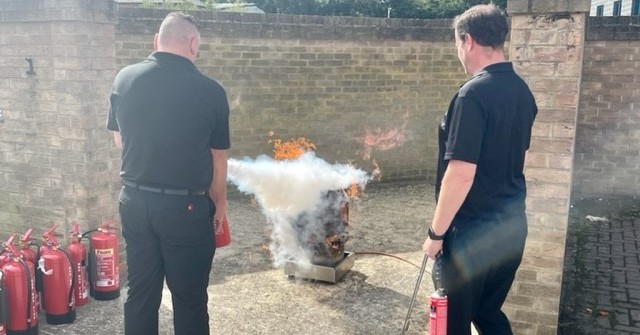
6. Services for training and education Training and education services: Only if those using the equipment are aware of how to operate it, will equipment be effective. Many service providers provide complementary training and education services, such as fire extinguisher courses (often with live fire simulations) and training for fire wardens and general fire safety awareness. This training empowers staff, increases safety and demonstrates your commitment to adherence.
7. The internet and the extensive documentation are essential. Today, top companies provide sophisticated documentation and not just certificates on paper. This includes digital service reports that are detailed with asset registers and online portals that allow users to view their entire service history as well as download certificates.
8. Disposal and Environmental Services: The responsible disposal of extinguishers decommissioned is a crucial environmental and legal requirement under Duty of Care regulations. Full-service providers will take care of this, employing licensed waste haulers and supplying Waste Transfer Notes to prove correct, legal disposal. This ensures you avoid the massive fines associated with the incorrect disposal of vessels that are pressurised as well as hazardous materials.
9. Planned Preventative Management (PPM) and Asset Management. The best providers go far beyond reactive calls to offer proactive contracts for PPM. The best PPM providers can manage your entire portfolio by keeping track of all service due date across different equipment, scheduling visits automatically, and giving you a clear maintenance schedule. It takes away the administrative burden and ensures that there is no service is missed.
10. Consultancy and Compliance Auditing: For larger or more complex sites, reputable providers provide consultation services. It could involve the gap analysis to determine if your current fire safety measures are in compliance with legal requirements. Experts can also give suggestions on how to improve your plans in addition to continuous compliance audits. See the top rated fire safety in Leamington Spa for website examples.